

Discovering Mathematics with Excel

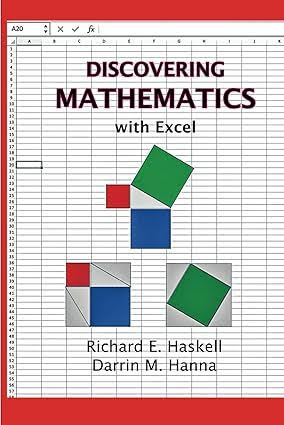
A new approach to learning first-year college mathematics using Excel spreadsheets. 11 chapters covering Discovering Mathematics, World of Numbers, Trigonometry, Probability and Statistics, Logic and Algorithms, Algebra, Geometry, Vectors, Calculus, Vector Differentiation, Differential Equations. Includes unique topics: fractal geometry and chaos.
More in Mathematics
Preface
Why do many college students majoring in engineering or science— perhaps you—find mathematics courses difficult? For the past seventy years, the math requirement for these majors has been two or three calculus courses followed by a differential equations course. The basic ideas of calculus are not complex, but solving calculus problems often requires the application of pre-calculus topics such as algebra, trigonometry, and geometry. You would have been introduced to these topics in high school but would benefit from a fresh, college-level approach. Other college-level math courses in linear algebra, discrete mathematics, probability and statistics, and number theory, if taken at all, are taken later in the curriculum, often as apparent add-on courses.
This book takes a new approach to a first-year mathematics course by showing you how to use Excel to discover the fundamentals of many areas of mathematics, including geometry, trigonometry, probability, logic, algorithms, algebra, vectors, calculus, and differential equations. In Chapter 1, you will learn why the transcendental numbers π and e have the values they do and what the imaginary number i = √−1 means. Also, by the end of Chapter 1, you will be able to use Excel to find the derivative and the integral of any one-dimensional function. Later chapters will explore these topics in more detail. By the end of this book, you will be a skilled user of Excel and can use it in future courses to discover much more.
You will meet many accomplished mathematicians of the past and learn how they struggled as hard as you do to understand different areas of mathematics. However, you have a significant advantage over the great past mathematicians. While they struggled with only paper and pencils, you can benefit from computers, particularly spreadsheet programs like Excel.
We will work through many Excel examples. We will tell you how to do these examples yourself, but if each Excel step isn’t clear, we have provided a short video on implementing each example. You can find all these videos at http://www.lbebooks.com/discovermath/.
So, what is mathematics? You’ll start discovering that in Chapter 1.
Richard E. Haskell
Darrin M. Hanna
Table of Contents
1. Discovering Mathematics
1.1 What is Mathematics
1.2 Euclid’s Elements
1.3 Finding the Circumference of a Circle
1.4 Golden Ratio and Fibonacci Sequence
1.5 Circular Functions
1.6 Exponents and Logarithms
1.7 Slopes and Derivatives
1.8 Areas and Integrals
1.9 Complex Numbers and Euler’s Equation
1.10 Summary and More Discoveries
Problems
2. Discovering the World of Numbers
2.1 Counting and Number Systems
2.2 Arithmetic Series and Triangular Numbers
2.3 Squares and Square Roots
2.4 Multiplications and Geometric Series
2.5 Prime Numbers
2.6 Counting and Choosing
2.7 The Binomial Theorem
2.8 Recurrence Sequences
2.9 Modular Arithmetic
2.10 Continued Fractions
2.11 Public-key Cryptography
Problems
3. Discovering Trigonometry
3.1 Trigonometric Functions
3.2 Sine and Cosine Waves
3.3 Trigonometric Identities
3.4 Congruent and Similar Triangles
3.5 Area of Triangles
3.6 Power Series and Trigonometric Functions
3.7 Excel Plots of Trigonometric Functions
3.8 Inverse Trigonometric Functions
Problems
4. Discovering Probability and Statistics
4.1 Flipping a Coin
4.2 The Normal Distribution
4.3 The Central Limit Theorem
4.4 Rolling Dice
4.5 Surprising Probabilities
4.6 Conditional Probabilities
4.7 Hypothesis Testing
4.8 Bayesian Inference
Problems
5. Discovering Logic and Algorithms
5.1 Logical Operations
5.2 Logic Gates
5.3 Positive and Negative Logic:
De Morgan’s Theorem
5.4 Design of Digital Circuits
5.5 Boolean Algebra
5.6 Design of Multiplexers
5.7 Algorithms
5.8 A GCD Algorithm
5.9 A Sorting Algorithm
Problems
6. Discovering Algebra
6.1 The Quadratic Equation
6.2 Solving Linear Equations
6.3 Solving Cubic Equations
Problems
7. Discovering Geometry
7.1 Triangles and Circles
7.2 Conic Sections
7.3 The Volume of a Cone and a Sphere
7.4 Doubling the Cube
7.5 Trisecting an Angle
7.6 Fractal Geometry
Problems
8. Discovering Vectors
8.1 Addition and Subtraction of Vectors
8.2 The Scalar or Dot Product
8.3 The Vector or Cross Product
8.4 The Index Notation
8.5 Orthogonal Curvilinear Coordinate Systems
Problems
9. Discovering Calculus
9.1 The Fundamental Theorem of Calculus
9.2 Differentiation
9.3 Integration
9.4 Implicit Differentiation
Problems
10. Discovering Vector Differentiation
10.1 Linear Motion
10.2 Projectile Motion
10.3 Circular Motion
10.4 Plane Curvilinear Motion
Problems
11. Discovering Differential Equations
11.1 Another Look at the Exponential Function
11.2 Computer Solutions of Differential Equations
11.3 Analytic Solutions of Differential Equations
11.4 Second-Order Differential Equations
11.5 Linear Systems of Differential Equations
11.6 Eigenvalues and Eigenvectors
11.7 Classifying Linear Systems Solutions
11.8 A General Second-Order Differential Equation
11.9 Predator-Prey Differential Equations
11.10 Discovering Chaos
Problems
Index
(377 pages)